Tall Office Workers: Why Conference Room Chairs Feel Worse Than Your Desk Chair
Quick Answer: Conference room chairs are almost always fixed-height, non-adjustable seating chosen for uniform appearance rather than ergonomics, unlike your desk chair which you’ve likely adjusted over time — the fix is a quick, discreet posture adjustment (sitting slightly forward, feet flat, table height permitting) rather than expecting the chair itself to adapt.
Your desk chair took weeks of small adjustments to get right for your height. Then you walk into a meeting and sit in a fixed conference chair that puts your knees higher than they should be and your shoulders hunched to reach the table.

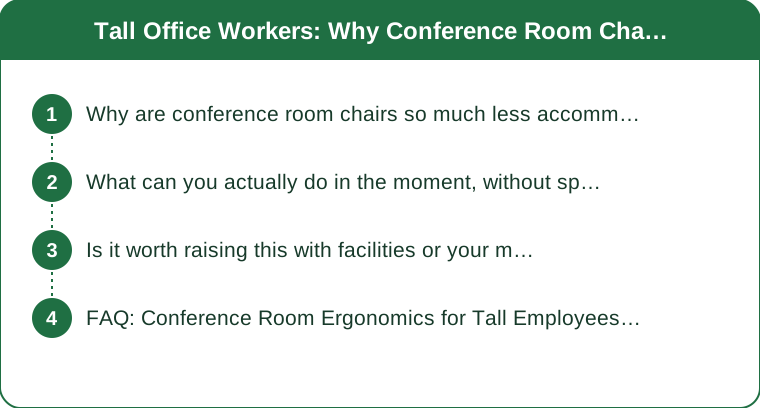
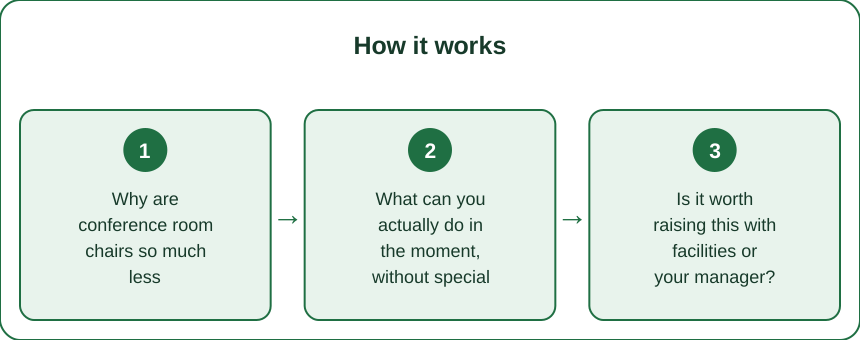
Why are conference room chairs so much less accommodating than desk chairs?
Conference room seating is typically chosen for visual consistency and cost across a large purchase order, not individual ergonomic adjustability. Desk chairs, by contrast, are usually a personal or role-specific purchase with height and tilt adjustment built in as a baseline expectation.
What can you actually do in the moment, without special equipment?
Sit slightly forward on the seat rather than pushed all the way back, which often lowers your effective knee height relative to a table that wasn’t designed with your legroom in mind. If the room has any chairs with even minor height adjustment, positioning yourself near one of those rather than a fully fixed model helps.

Is it worth raising this with facilities or your manager?
Yes, especially if you’re in meetings for a significant part of your week — flagging a genuine ergonomic mismatch is a reasonable, common request, not an oversized ask. Some offices keep one or two adjustable chairs on hand specifically for this kind of feedback once it’s raised.
FAQ: Conference Room Ergonomics for Tall Employees, Answered
Does bringing a cushion help with this specific problem?
A cushion helps more with seat height than knee room, so it’s a partial fix — it raises you overall but doesn’t solve a table that’s positioned too low relative to your legs.
Should I request my own portable chair for meetings?
Some people do keep a compact folding ergonomic chair for exactly this reason, though it’s a more visible solution than most people choose to use regularly.
Is this a common enough complaint that companies actually respond to it?
Yes — ergonomic mismatches are a recognized workplace issue, and most facilities teams have handled similar requests before, even if conference room seating changes slowly.
TL;DR:
- Conference room chairs prioritize visual consistency over individual ergonomic fit
- Sitting slightly forward on the seat is the quickest in-the-moment adjustment
- Flagging the mismatch to facilities or a manager is a reasonable, common request
- A cushion helps seat height more than it helps knee room under a low table
Your desk chair took weeks to dial in — don’t expect a shared conference chair to match it without a small adjustment on your part.
Keep Reading
This article is for general informational and styling purposes only. Fit, sizing, and product availability may vary.