Why Your Chair Is the Wrong Thing to Fix First When You Are Tall
Quick Answer: Desk height is the constraint, not the chair. Standard desks are around 29 inches, set for an average user, and a tall person needs closer to 30 to 32 inches seated. Raising a chair to reach a low desk lifts your feet off the floor and moves the problem to your legs. Raise the desk first, then the monitor, then adjust the chair.
You bought the ergonomic chair. You adjusted the lumbar support, the armrests, the tilt, and the seat depth.
And your shoulders still ache at four o’clock, and your neck is worse than it was, and the chair cost a great deal of money.
The chair was probably fine. It is the third thing to fix, and fixing it first is why the improvement was so small.

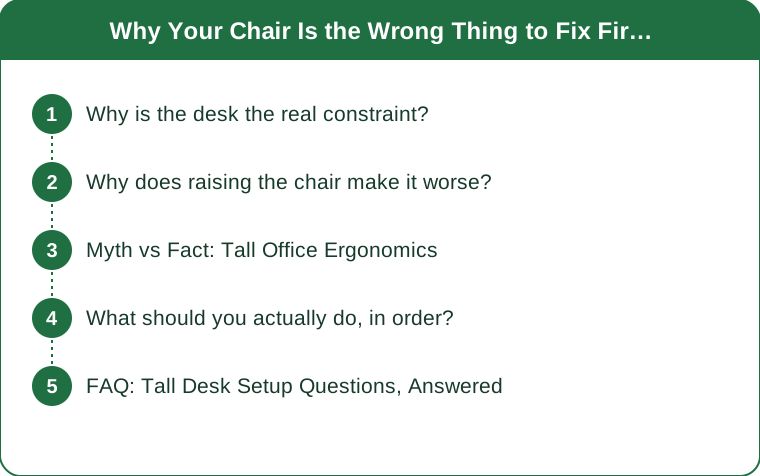
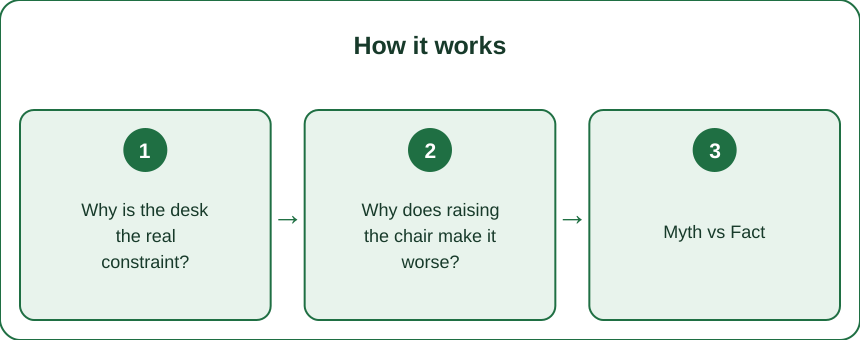
Why is the desk the real constraint?
Because everything else is adjustable and the desk usually is not.
Standard desk height is around 29 inches, and that figure has been essentially unchanged for decades. It derives from mid-twentieth-century averages and it suits someone around 5ft 8 with a keyboard on the surface.
A person at 6ft needs a seated working surface closer to 31 or 32 inches. That is a difference of two to three inches, which does not sound like much and determines the position of your entire upper body.
At a desk that is too low, you have three options and all of them are bad. You can lower the chair, which drops your eyeline further below the monitor and puts your knees above your hips. You can lean forward, which loads the lower back and neck. Or you can keep the chair high and let your arms angle downward, which forces the wrists into extension and lifts the shoulders as you reach forward and down.
Most tall people do the third one without noticing, and the resulting shoulder and wrist complaints get blamed on the mouse or the chair.
The chair is genuinely adjustable. The monitor is adjustable, or can be made so for very little. The desk is the fixed variable, which is exactly why it should be fixed first.
Why does raising the chair make it worse?
Because it solves the arm angle by creating a leg problem.
Raise a chair until your forearms are level with a 29-inch desk and, if you are tall, your feet are still on the floor - which sounds like a success. The issue is what happened to your thighs. Seat height set for the desk rather than for your leg length means the front edge of the seat presses into the back of your thighs, which restricts circulation and, over hours, produces the numbness and restlessness tall people often report.
It also changes the hip angle. A seat that is too high relative to your leg length tilts you forward, and a seat too low puts knees above hips and flattens the lumbar curve. There is one correct seat height for your legs, and it is determined by your legs, not by the desk.
A footrest is a fix for short users at a tall desk, not for tall users at a short one. Tall people rarely need one, and reaching for it is usually a sign that the chair has been raised to compensate for the desk.
The correct order removes the conflict entirely. Set the chair for your legs. Set the desk for your arms. Set the monitor for your eyes. Each of the three is then solving one problem instead of three at once.

Myth vs Fact: Tall Office Ergonomics
Myth: An expensive chair fixes a bad setup. Fact: A good chair on a low desk is a good chair in the wrong position. The chair market is enormous and well marketed, and the desk market is where the actual constraint lives.
Myth: Standing desks solve tall problems automatically. Fact: They solve them only if the range goes high enough, and a surprising number of budget models top out around 47 inches - too low for comfortable standing work above about 6ft. Check the maximum height, not just that it is adjustable.
Myth: A laptop stand is enough. Fact: A laptop stand fixes the screen and breaks the keyboard, because they are attached. It only works paired with an external keyboard, and the two are a package rather than an upgrade path.
Myth: You should be able to feel a difference immediately. Fact: A correct setup often feels unremarkable, because comfort is the absence of a signal. The improvement usually shows up as not aching at four o’clock rather than as feeling great at nine.
Myth: Desk risers look bad and are a bodge. Fact: Sturdy desk risers or replacement legs cost very little and are a permanent fix. Aesthetics aside, a stack of solid risers under a desk you already own outperforms almost any chair upgrade for a tall worker.
What should you actually do, in order?
Three steps, done in this sequence, with a tape measure.
Step one: set the chair for your legs. Feet flat on the floor, thighs roughly horizontal or very slightly declined, no pressure at the front edge of the seat, hips level with or just above the knees. Ignore the desk entirely while you do this. Note the resulting elbow height from the floor - that is your target desk height.
Step two: raise the desk to that number. Options in rough order of cost: solid desk risers under the existing legs, replacement legs, adjustable legs, or a sit-stand desk with a verified maximum height. Confirm the model’s range before buying, since this is where tall buyers get caught.
Step three: put the monitor at eye level. The top of the screen at or just below eye height, an arm’s length away. On a raised desk this usually means a monitor arm or a riser, and a monitor arm is the single best value item in a tall person’s setup.
Then, and only then, adjust the chair’s fine settings - armrests to support your forearms without lifting the shoulders, lumbar support to the curve of your lower back, tilt to taste.
A few extras that matter disproportionately for tall workers: an external keyboard and mouse always, since a laptop cannot put the screen and hands in the right places simultaneously; check the desk depth, because longer arms need more room and a shallow desk forces the monitor too close; and check for knee clearance, since raising a desk on risers can leave a drawer unit or a crossbar in the way.
And move regularly regardless. The best setup held motionless for four hours is worse than an average one you get up from every half hour.
FAQ: Tall Desk Setup Questions, Answered
What if I cannot modify my desk at work?
Raise the monitor and the keyboard instead - a monitor arm clamped to the desk plus a keyboard tray or an angled stand gets you a good way there. It is also a reasonable thing to raise with your employer, since workstation assessment is a standard part of occupational health.
How high should a standing desk go for a tall person?
Standing elbow height is the target, which for someone at 6ft is typically around 44 to 46 inches, and taller than that for anyone above. Look for a stated maximum well above your requirement rather than exactly at it, since desktop thickness eats into the range.
Is a kneeling chair or a ball worth trying?
Both get recommended and neither addresses the desk height problem, which is the one you have. They change the seated posture rather than the arm and eye geometry, so they are worth considering only after the desk and monitor are right.
TL;DR:
- Standard desks are about 29 inches, set for average height, and a tall person needs two to three inches more.
- Raising the chair to reach a low desk creates a thigh and hip problem while only partly solving the arm one.
- Fix in order: chair for your legs, desk for your arms, monitor for your eyes - each solving one thing.
- Desk risers and a monitor arm cost a fraction of an ergonomic chair and address the actual constraint.
If an expensive chair barely helped, that is information rather than disappointment. Measure your elbow height sitting properly, compare it to your desk, and fix the number that has been wrong the whole time.
Keep Reading
This article is for general informational and styling purposes only. Fit, sizing, and product availability may vary.