Why Tall Workers Should Fix the Commute Before the Desk
Quick Answer: Desk ergonomics get all the attention because they are visible and adjustable, but for many tall office workers the commute contributes more sustained poor positioning than the desk does - fixed train seat pitch, car seats with limited rearward travel, and bag carriage over the same shoulder daily. Fix the commute first: adjust the car seat properly including height and steering position, choose train seating deliberately, switch to a rucksack, and break up the sitting at both ends.
You got the chair sorted, the monitor raised and the keyboard right.
Your back is exactly as unhappy as it was, and the only thing you have not looked at is the eighty minutes a day you spend getting there.

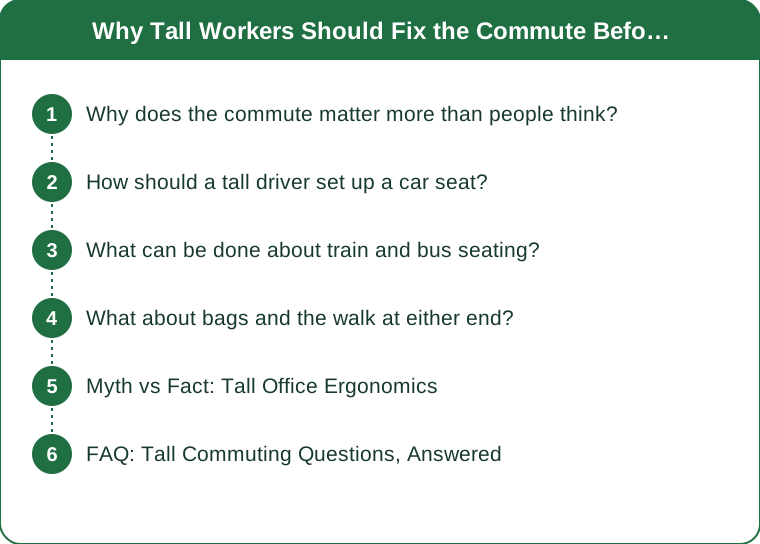
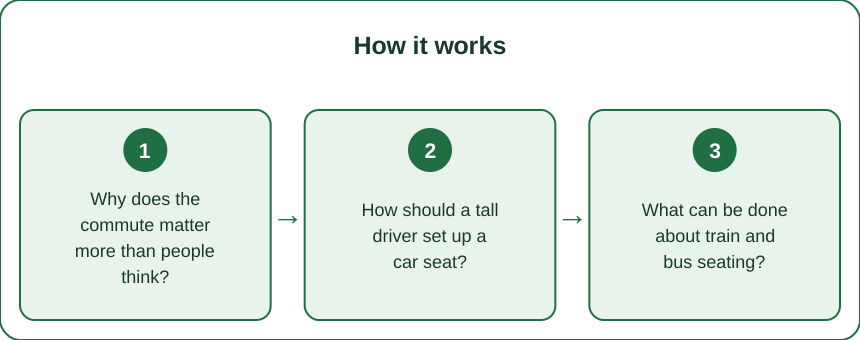
Why does the commute matter more than people think?
It is often as long as several hours of desk time across a week, in a position with far less adjustability.
Train seat pitch is fixed and set for average leg length, which means a tall passenger has no adjustment available at all.
Car seats have limited rearward travel, so a tall driver often ends up with knees high, seat back reclined too far, and a reach to the wheel that rounds the shoulders.
Bag carriage is asymmetric and daily, which is one of the more consistent postural loads most office workers experience.
And it happens at both ends of the day, including immediately before sitting at a desk for hours - so a bad commute position is a warm-up for a long static period.
Meanwhile the desk is the one part you can adjust, which is why it absorbs all the attention.
How should a tall driver set up a car seat?
Start with height, not distance. Most tall drivers lower the seat fully for headroom and then cannot see or reach comfortably. Set height first, then distance.
Slide back far enough that your knees are below your hips, if the travel allows, which reduces the pelvic tilt that produces lower back load.
Bring the steering wheel toward you rather than reaching for it, since most wheels adjust for reach as well as height and almost nobody uses the reach adjustment.
Set the backrest more upright than feels natural, since a reclined back with a forward head position is the classic long-commute posture.
Check lumbar support if the car has it, and use a small cushion if it does not.
And adjust the mirrors after setting the seat, which forces you to maintain the position rather than drifting back into a slouch.
What can be done about train and bus seating?
Choose your seat deliberately rather than taking the first one. Aisle seats, seats at table bays and seats by doors all offer more leg room than a standard forward-facing pair.
Face the direction that lets you angle your legs into the aisle, which is the practical workaround for fixed seat pitch.
Stand for part of a longer journey rather than sitting badly for all of it, which many tall commuters find genuinely more comfortable.
Avoid working on a laptop on your knees, which combines the worst neck position available with an already compromised seat.
Use the journey for the movement you will not get later - shoulder rolls, thoracic rotation, ankle circles - which is unglamorous and effective.
And check whether an earlier or later train is materially quieter, since seat choice depends entirely on availability.

What about bags and the walk at either end?
Switch to a rucksack. It is the single highest-return change for anyone carrying a laptop daily, and shoulder bags produce a sustained asymmetric load.
Adjust the straps so the bag sits high on the back, not low near the hips, which is where most people wear them and where they pull the shoulders back and down.
Reduce what you carry. Most commuter bags contain items that live there permanently and are used rarely, and weight is the variable you control most easily.
Use the walk deliberately. The walking portion of a commute is the movement break that the rest of the day lacks, and lengthening it slightly is a genuinely effective intervention.
Alternate sides if you must use a shoulder bag, which is a partial fix rather than a good one.
And stand and move for a few minutes on arrival before sitting down at a desk, rather than transferring straight from one seated position to another.
Myth vs Fact: Tall Office Ergonomics
Myth: getting the desk right solves office back trouble.
Fact: the desk is one part of a day that also includes commuting, meetings and standing at the wrong height. For many tall workers the desk is the best-adjusted part of the day.
Myth: taller people should always lower the car seat.
Fact: headroom often forces this, but setting height first and then distance produces a better position than lowering fully and reaching. Reach adjustment on the steering wheel is widely available and rarely used.
Myth: a standing desk fixes everything.
Fact: standing all day produces its own problems, and standing desks are frequently set at the wrong height for tall users because they are chosen from a standard range. Alternating positions is the actual benefit.
Myth: posture is the main variable.
Fact: position duration matters at least as much as position quality. The best sitting posture held for three hours is worse than an imperfect one broken up every thirty minutes.
Myth: rucksacks look unprofessional.
Fact: this stopped being true some time ago, and the daily asymmetric load from a shoulder bag is a genuine and avoidable cost. This is general information, not medical advice.
FAQ: Tall Commuting Questions, Answered
What should I adjust first in a car?
Seat height, then distance, then backrest angle, then steering wheel reach and height, then mirrors. Setting mirrors last locks in the position.
Which train seats are best for tall passengers?
Aisle seats, table bays and seats near doors generally offer the most leg room. Facing a direction that lets you angle your legs into the aisle is the practical workaround for fixed pitch.
Is a rucksack really better than a shoulder bag?
For daily carriage of a laptop, yes. It distributes the load symmetrically rather than tilting the shoulders, and the effect accumulates over months of commuting.
How high should a rucksack sit?
High on the back with the straps adjusted so it does not hang near the hips. Low-slung bags pull the shoulders back and down and increase the load.
Should I stand on a long train journey?
Many tall commuters find standing for part of a journey more comfortable than sitting in fixed-pitch seating for all of it. Alternating is generally better than either alone.
Does a standing desk help tall workers?
Only if it adjusts high enough, which standard models sometimes do not. Check the maximum height against your elbow height before buying.
When should I get back or neck pain looked at?
Pain that persists, worsens, or comes with numbness, tingling or arm or leg symptoms should be assessed by a qualified healthcare professional. This is general information, not medical advice.
TL;DR:
- The commute is often as long as several hours a week in a position with far less adjustability than a desk.
- Set car seat height first, then distance, then backrest, then steering wheel reach - and mirrors last.
- Choose train seating deliberately and stand for part of long journeys rather than sitting badly for all of it.
- Switch to a rucksack worn high on the back; a daily shoulder bag is a sustained asymmetric load.
- Position duration matters as much as position quality - break up sitting at both ends.
Fix the unadjustable part of the day before optimising the adjustable one. This is general information, not medical advice.
Keep Reading
This article is for general informational and styling purposes only. Fit, sizing, and product availability may vary.