The Standard Office Desk Height Problem Nobody Mentions Until Your Knees Hit It
Quick Answer: Standard office desks are typically built around a fixed height calibrated to an average seated eye level and legroom clearance, which means taller employees often hit knee clearance limits or end up with a mismatched chair-desk height ratio — a height-adjustable desk, a chair with a wider height range, or simply raising a fixed desk with sturdy risers all address this more effectively than adjusting posture to compensate.
Desk height complaints usually get chalked up to chair adjustment alone, but for taller employees, the desk’s fixed clearance itself is frequently the real limiting factor.

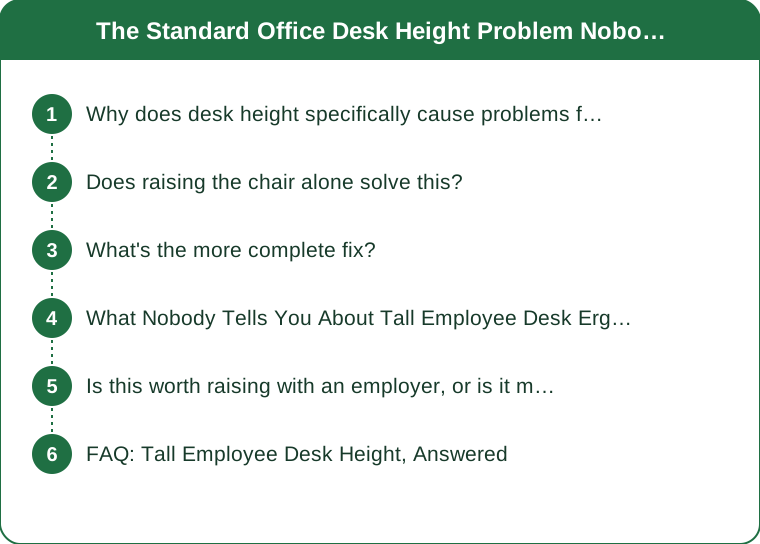
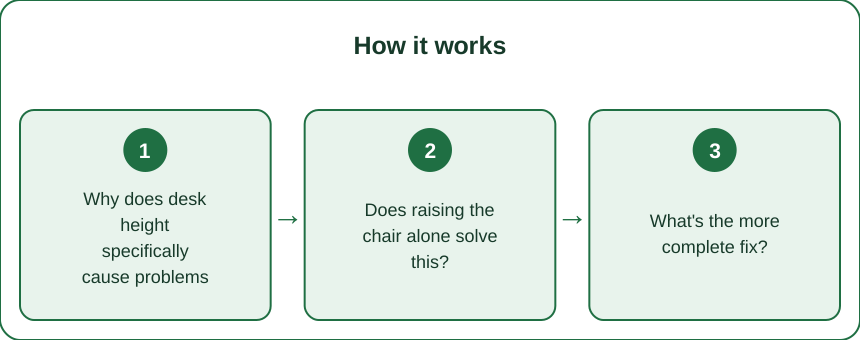
Why does desk height specifically cause problems for taller employees?
A standard fixed-height desk (commonly around 29-30 inches) is built around average adult leg length and torso proportions, which leaves less usable knee clearance for a taller frame with proportionally longer thighs — even with the chair raised to a comfortable seated height, taller employees can find their knees hitting the underside of the desk before finding a full comfortable position.
Does raising the chair alone solve this?
Only partially, and it introduces a new problem. Raising a chair enough to clear a fixed low desk often puts feet below a stable floor-contact position, requiring a footrest to compensate — a workaround that solves one problem but adds another piece of equipment and doesn’t address the root desk-height mismatch.
What’s the more complete fix?
A height-adjustable desk (electric or manual crank) is the most direct fix, since it allows desk height to actually match the individual rather than forcing a compromise through chair and footrest adjustments alone. Sturdy desk risers on a fixed desk are a lower-cost alternative that raises the whole desk surface, which — combined with an appropriately raised chair — can achieve a similar result without a full desk replacement.

What Nobody Tells You About Tall Employee Desk Ergonomics
Many workplaces have an ergonomic assessment or accommodation request process that applies to height-related fit issues, not just injury-related ones — it’s worth asking HR or facilities directly, since a formal ergonomic assessment sometimes unlocks equipment (an adjustable desk, a different chair) that wouldn’t otherwise be provided by default. Monitor height compounds the desk height problem — a monitor set at a standard height, paired with a desk that’s already too low, forces a downward neck angle that adds strain on top of the legroom issue, so both need addressing together, not just one.
Is this worth raising with an employer, or is it more of a personal preference issue?
Genuinely worth raising as an ergonomic concern, not just a preference — a consistently poor desk-height fit contributes to real, documented strain (knee, back, neck) over the course of regular full-time desk work, which is squarely within the kind of workplace ergonomic issue employers are generally expected to accommodate.
FAQ: Tall Employee Desk Height, Answered
What’s a reasonable desk height range to request for a taller employee?
This varies by individual proportions, but a height-adjustable desk that can go above the standard 29-30 inch range (into the low-to-mid 30s or higher) covers most taller employees — the point of an adjustable desk is testing and dialing in the actual right height for you specifically, not hitting one universal number.
Are standing desk converters a good workaround if a full adjustable desk isn’t available?
Yes, a reasonable middle option — they sit on top of an existing fixed desk and add their own height adjustment, which can meaningfully help even without replacing the base desk.
Should monitor height be adjusted at the same time as desk height?
Yes, ideally together — adjusting one without the other often just shifts the strain from knees to neck or vice versa rather than actually resolving it.
TL;DR:
- Standard fixed desk height is calibrated to average proportions, limiting knee clearance for taller employees
- Raising the chair alone often creates a new footrest-dependency problem rather than solving the root issue
- A height-adjustable desk or sturdy risers address the mismatch more completely than chair adjustment alone
- Monitor height should be adjusted alongside desk height, not treated as a separate issue
Knee clearance and neck strain from a too-low desk aren’t something a taller employee should have to just work around indefinitely — it’s a legitimate, fixable ergonomic mismatch worth raising directly.
Keep Reading
This article is for general informational and styling purposes only. Fit, sizing, and product availability may vary.