Why a Footrest Is the Wrong Fix for a Tall Desk Setup
Quick Answer: A footrest exists to support the feet when a chair has been raised above a person’s leg length to reach a fixed-height desk. Tall users have the opposite problem: the desk is too low, so raising the chair makes the desk worse and lowering it drops the knees below the hips. The correct fix is to raise the desk with risers or a height-adjustable frame, then set the chair to your leg length. A footrest under a tall user simply removes the last bit of legroom.
Standard office desks are built around a fixed height that was never designed for a longer frame.
We have covered the desk setup most tall people get wrong, standing desk height adjustment, and why an anti-fatigue mat throws off a tall setup. This is the piece of advice worth actively ignoring.

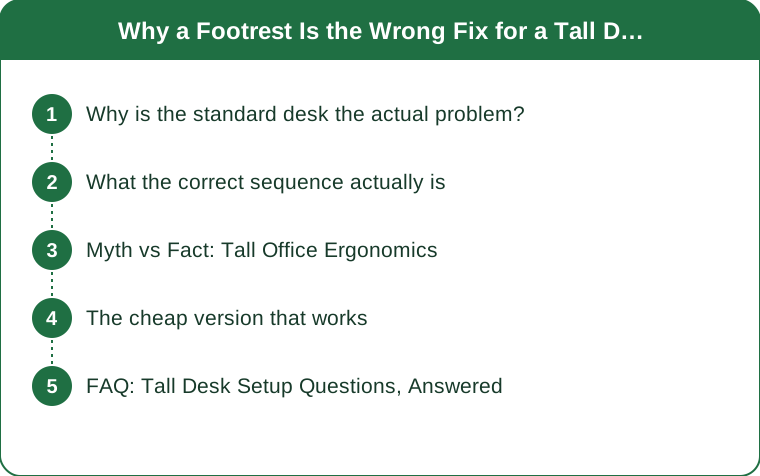
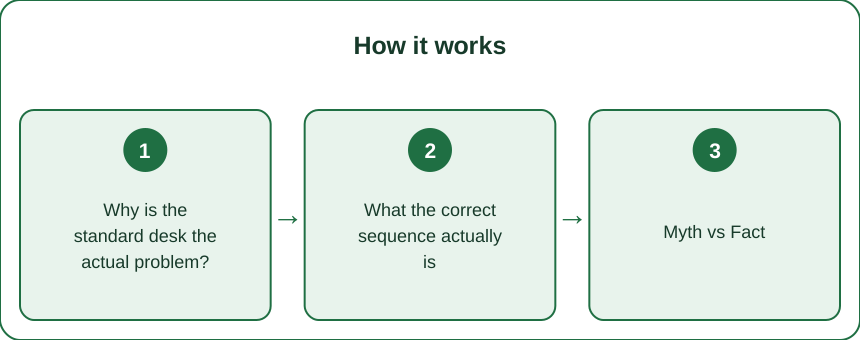
Why is the standard desk the actual problem?
Because it is a fixed dimension chosen for an average that most tall people are well outside.
Most fixed office desks sit around 73 to 75 centimetres. That height was standardised decades ago around an average seated user.
Correct desk height is roughly at your seated elbow height with shoulders relaxed and forearms level. For a taller person that is frequently 78 to 82 centimetres or more.
Every centimetre of shortfall shows up in your shoulders. Too low a desk means you either drop your shoulders and round forward, or you drop the chair and lose the leg position.
Lowering the chair to meet the desk drops your knees below your hips, which tilts the pelvis backward and rounds the lower back.
Raising the chair improves the back and worsens the desk relationship, because the desk is already too low relative to your elbows.
And a footrest addresses neither. It is designed for someone whose feet do not reach the floor, which is essentially never the tall user’s situation.
What the correct sequence actually is
Six steps, in this order, because the order is the whole point.
Set the chair to your body first. Feet flat, knees at roughly ninety degrees or slightly open, thighs level or angled very slightly down.
Now measure your seated elbow height. Shoulders relaxed, upper arms hanging, forearms horizontal. That number is your target desk height.
Raise the desk to that height. Desk risers, sturdy blocks under the legs, or a height-adjustable frame. This is the step people skip and it is the one that matters.
Set the monitor top at or slightly below eye level, roughly an arm’s length away. On a raised desk this usually means a lower monitor stand than you had before, not a higher one.
Check the keyboard position. Elbows at about ninety degrees, wrists straight, keyboard close enough that your upper arms stay near your body.
Then check legroom under the raised desk. More height usually means more clearance, which is a rare case of two problems solving each other.
And if the desk genuinely cannot be raised, raise the chair and use a footrest as a last resort — that is the one situation where it is the correct tool, and it should be a considered compromise rather than a first suggestion.

Myth vs Fact: Tall Office Ergonomics
Myth: A footrest is standard good ergonomic advice. Fact: It is standard advice for shorter users at fixed-height desks. For a tall user it removes legroom and does nothing about the desk being too low.
Myth: Ergonomic guidance applies to everyone equally. Fact: Most published guidance is built around a mid-range user. The principles hold; the specific numbers frequently do not.
Myth: A standing desk solves everything. Fact: It solves the height problem if the range goes high enough, and many models top out below what a tall user needs standing. Check the maximum height before buying, not the minimum.
Myth: A bigger chair is the answer. Fact: Seat depth and back height matter, but the chair cannot fix a desk that is too low. Chair first, then desk, in that order.
Myth: Raising the monitor is always right. Fact: On a correctly raised desk the monitor often needs to come down. Eye level is the target, and raising the desk raises the monitor with it.
Myth: A laptop on a riser with a separate keyboard is over the top. Fact: For a tall user it is close to essential. A laptop screen and keyboard at the same height force either a bent neck or raised shoulders, and there is no position that avoids both.
The cheap version that works
You do not need a new desk to fix most of this.
Desk risers under the legs cost very little and give you five to fifteen centimetres, which is usually the entire gap.
A separate keyboard and mouse plus a laptop stand is the single highest-value change for anyone working on a laptop, and it is inexpensive.
A chair with a proper seat depth adjustment matters more than most features for a longer femur. Without it, the seat edge presses behind the knee.
A monitor arm rather than a stand gives you the fine adjustment that a fixed stand will not, and it frees desk depth as well.
Check the seat back height. Many standard chairs support the lower back at the wrong point on a longer torso, and a chair with an adjustable lumbar position solves it.
And measure before you buy anything. Seated elbow height, seated knee height and eye height, written down. Three numbers, and they turn ergonomic shopping from guesswork into arithmetic.
If you work in a shared or hot-desking office, carry a small laptop stand and set the chair each time. The desk you cannot change; the two things above it you can, in about a minute.
FAQ: Tall Desk Setup Questions, Answered
Should tall people use a footrest?
Generally no. A footrest supports feet that cannot reach the floor, which happens when a chair is raised to meet a fixed desk. Tall users usually need the desk raised instead, and a footrest simply consumes legroom.
How high should my desk be if I am tall?
At your seated elbow height with shoulders relaxed and forearms horizontal. For many taller users that is 78 to 82 centimetres or more, against a standard desk of 73 to 75.
What is the cheapest fix for a desk that is too low?
Risers under the desk legs. They cost very little, give you the five to fifteen centimetres that usually closes the gap, and they raise your monitor along with everything else.
TL;DR:
- A footrest solves the short-user problem. The tall-user problem is a desk that is too low, and a footrest makes legroom worse.
- Set the chair to your body first, measure your seated elbow height, then raise the desk to match.
- On a correctly raised desk the monitor usually needs to come down, not up.
- Risers under the desk legs are the cheapest fix and usually close the whole gap.
Fix the desk, not your feet. Everything else follows from that one measurement.
Keep Reading
This article is for general informational and styling purposes only. Fit, sizing, and product availability may vary.