The Keyboard Tray Height Mistake Making Tall Office Workers' Wrists and Shoulders Ache
Quick Answer: Standard keyboard trays are set at a fixed height assuming an average forearm length and seated height, which forces taller workers to either hunch shoulders up to reach a too-low tray or raise the chair so high their feet no longer touch the floor — the fix is decoupling chair height from keyboard height using a separately adjustable tray.
You raise your chair so your legs finally fit under the desk, and now your feet dangle and your keyboard sits at your ribcage. Every fix creates a new problem.

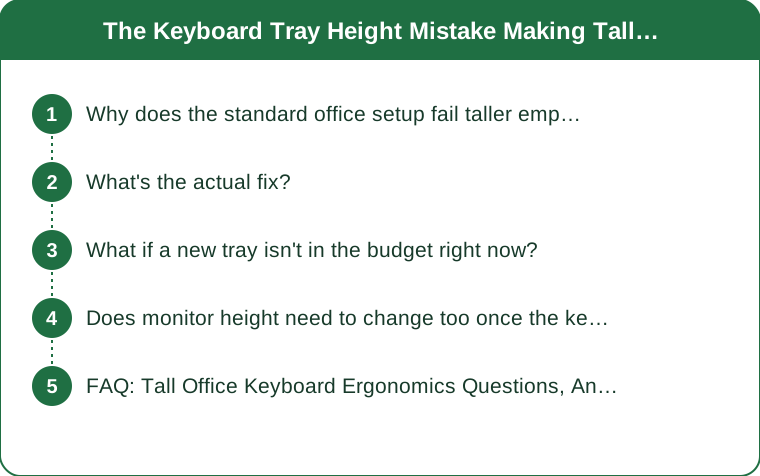
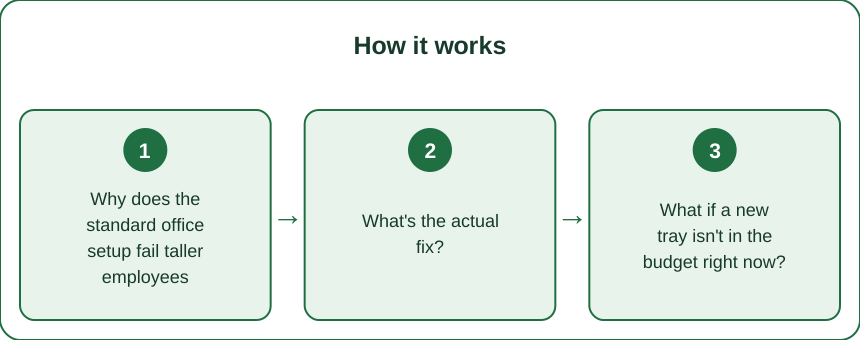
Why does the standard office setup fail taller employees specifically?
Most desks and keyboard trays are built around a single average seated-elbow height, so they work fine when your chair height matches that average — but a taller frame usually needs a higher chair for leg clearance, which then puts the fixed-height tray or desk surface too low relative to your new seated position.
What’s the actual fix?
A separately height-adjustable keyboard tray (not fixed to the desk height) lets you set the chair for proper leg and hip position first, then set the keyboard height independently so your elbows stay at roughly 90 degrees without your shoulders rising to compensate.

What if a new tray isn’t in the budget right now?
Raise the chair to correct leg position and add a footrest if your feet no longer reach the floor — a stack of sturdy books works in a pinch — this at least fixes the more damaging half of the problem (hip/knee strain) while you sort out the keyboard height separately.
Does monitor height need to change too once the keyboard is fixed?
Yes — once your seated eye height changes from adjusting the chair, the monitor top should realign to eye level, usually via a monitor arm or a stand, so you’re not trading wrist strain for neck strain.
FAQ: Tall Office Keyboard Ergonomics Questions, Answered
Is a standing desk a simpler fix than adjusting a seated setup?
It can be, since standing desks with electric height adjustment accommodate a wider height range more easily than fixed seated furniture — but the same tray-height principle still applies at standing height.
How do I know if my keyboard height is actually wrong?
Check your wrist angle while typing — if your wrists bend upward noticeably (extension) rather than staying flat or slightly angled down, the tray is too high relative to your elbow.
Should HR or facilities provide ergonomic equipment for tall employees?
Many companies have an ergonomics accommodation process specifically for this — it’s worth asking, since separately adjustable trays and monitor arms are inexpensive relative to the injury risk they prevent.
TL;DR:
- Standard desks assume one average seated-elbow height that doesn’t scale with chair height
- A separately adjustable keyboard tray fixes both leg clearance and wrist angle
- Fix chair/leg position first, then tray height, then monitor height
- Ask about an ergonomics accommodation process at work — it’s a common ask The ache isn’t about your posture discipline — it’s a furniture height mismatch with a real, inexpensive fix.
Keep Reading
This article is for general informational and styling purposes only. Fit, sizing, and product availability may vary.