Why Blazers Pull at the Elbow First on Long Arms
Quick Answer: Tailored sleeves are cut with a built-in curve — a drafted elbow — placed for average arm length. On long arms your real elbow sits below the garment’s, so every bend fights the fabric above the seam it was given: the sleeve pulls at the elbow, creeps up the wrist, and creases in the wrong place. Desk work makes it worse because typing holds the bend for hours. The fixes are tall sleeve lengths, knit and stretch constructions, functional cuffs with hem allowance, and refusing to buy shoulder fit you do not have.
Here is the drafting problem, the buying checks, and the rotation that survives long arms.

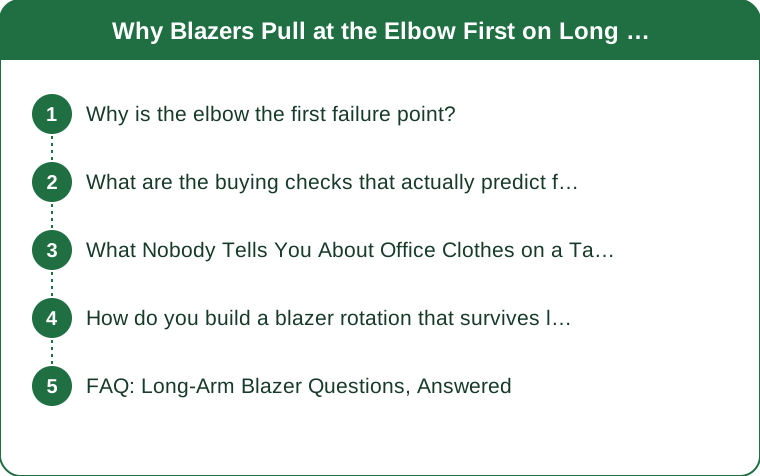
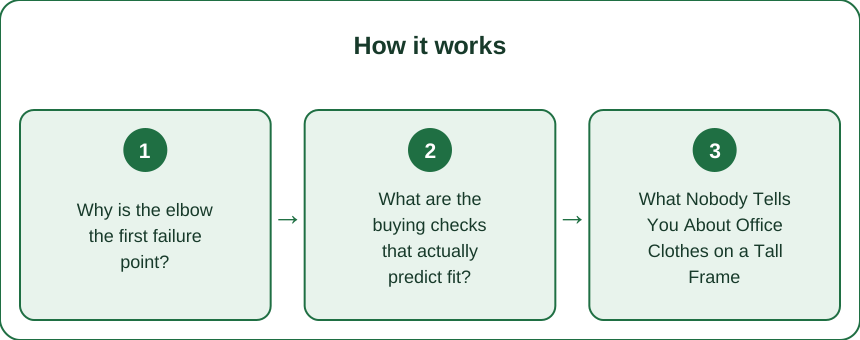
Why is the elbow the first failure point?
Because a good sleeve is not a tube — and the shaping in it has an address.
Tailored two-piece sleeves are drafted with a forward curve at a specific height, mirroring an arm hanging with a natural slight bend. That construction is why quality jackets look alive rather than stovepipe-straight. The curve’s position is proportional to the fit model — a woman of average height with average arm length.
A long arm relocates the bend below the drafting. When your elbow flexes an inch or two under the garment’s shaped zone, the fabric above your joint has to fold where it was never eased to fold. The result is the tall-blazer signature: diagonal pull lines radiating from the elbow, a sleeve that rides toward the forearm with every bend, and permanent creasing at a height where the sleeve has no shaping to absorb it.
Desk posture turns an occasional mismatch into an all-day one. Typing holds elbows at roughly ninety degrees for hours, keeping constant tension on exactly the wrong zone. Each reach to the keyboard hikes the cuff; the sleeve does not fully recover; by afternoon it sits visibly short and twisted, and you have adjusted it forty times without noticing.
Length shortfall then amplifies everything. A sleeve that barely reaches the wrist bone when straight loses real ground the moment the arm bends — bending consumes length. This is why a sleeve that photographed fine in the mirror runs an inch short at the desk, and why tall arms need bend-length, not standing-length.
What are the buying checks that actually predict fit?
Test the bend, read the construction, and never trade the shoulder for the sleeve.
1. The keyboard test, in the fitting room. Bend both arms to ninety degrees and hold them as if typing for ten seconds. The cuff should stay within reach of the wrist bone and the elbow should feel room, not resistance. A blazer assessed only with arms hanging has not been assessed.
2. Shoulder first, always. The shoulder seam must land at your shoulder point — it is the one seam a tailor cannot move meaningfully. Buying a bigger size to gain sleeve length buys collapsed shoulders and a boxy body; buying tall ranges buys length with the shoulder left correct. Sleeve length is purchasable; shoulder fit is not negotiable.
3. Read the cuff hardware. Functional buttonholes look premium but lock the hem — lengthening becomes a major alteration. Non-functional buttons with a plain hem and visible allowance mean a tailor can release up to an inch. On long arms, the cheaper cuff is the better cuff.
4. Check the fabric’s give. A few percent elastane in a woven, or a knit blazer construction, lets the fabric follow a misplaced bend instead of fighting it. Ponte and jersey blazers are the peace treaty for long arms: structure in the silhouette, surrender at the elbow.
5. Look for tall ranges with real numbers. Brands that publish sleeve length in inches — measured from shoulder seam — are telling you they measured. Tall blazer cuts typically add one and a half to two inches of sleeve, which is precisely the gap the drafting left.
6. And read reviews for the word sleeves. Long-armed buyers report the shortfall in exactly one word, and their returns are the cheapest research available.

What Nobody Tells You About Office Clothes on a Tall Frame
Your desk setup is wearing your wardrobe. The lower your chair relative to the desk, the higher your reach angle and the harder every sleeve rides. Raising the chair and dropping the keyboard does not just fix your wrists — it visibly extends the working length of every jacket you own.
Elbow shine is a tall tax. Constant fabric tension over the elbow point polishes wovens into a shiny patch — the reason your favourite blazer aged at the elbow a year before anywhere else. Steam revives it briefly; rotation prevents it. A blazer worn daily at a desk dies at the elbow first, always.
Bracelet-length is a style; short is a mistake — and the difference is deliberateness. A sleeve ending cleanly mid-forearm with a rolled or designed edge reads intentional; a sleeve straining toward a wrist it cannot reach reads outgrown. When length runs out, push the sleeve up decisively rather than letting it hover. Owning the crop beats apologising for it.
The wrist gap is a winter problem you can solve in August. The sliver of forearm between cuff and glove line becomes obvious the first cold week; long-cuffed knits layered under blazers, and sleeves with thumbholes on athleisure-adjacent layers, close it. End-of-summer sales are when those layering pieces are cheap and stocked.
Stretch bottoms quietly carry the office-comfort load. A structured top half over a stretch bottom half is the tall-office formula: ponte trousers or polished bootcut yoga pants deliver the pressed-pant line with none of the seated hostage-taking — and on long legs the bootcut’s slight flare balances the longer line better than a skinny hem ever did. It is the half of office comfort nobody sees and every long-limbed desk worker feels by 3pm.
How do you build a blazer rotation that survives long arms?
Three constructions, two lengths, and maintenance that targets the elbow.
The structured one — bought tall, worn for stakes. One true tall-cut woven blazer with the shoulder correct and sleeve honest, for interviews, presentations, and clients. This is where the tall range earns its price; buy it dark, buy it once, and let a tailor perfect the cuff.
The knit one — worn most. A ponte or jersey blazer carries the daily desk load: the elbow moves freely, the sleeve recovers instead of creeping, and the shoulder forgives. It will quietly become the most-worn tailored piece you own, because it is the one that never fights the keyboard.
The unstructured one — the heat-and-layering flex. Soft, unlined, slightly relaxed; sleeves push up deliberately, which converts the length problem into a styling choice. In late summer this is the blazer that works over a sleeveless top at a cold desk under aggressive AC while the sidewalk outside is still 88 degrees.
Two length notes for long torsos as well as long arms: longline blazer bodies balance long legs and cover the high-hip zone that standard hems abandon on tall frames, and sleeve and body length tend to travel together in tall ranges — solving one usually solves both.
Maintenance is elbow-first: steam the elbow zone rather than ironing it flat — pressing sets the shine you are trying to avoid; rest each woven a day between wears so the fibres recover their loft; and re-check cuffs seasonally, because sleeves effectively shorten as shoulders and posture change with training.
The rotation’s logic is simple: give the drafted-elbow problem to fabrics that can absorb it, and reserve the rigid tailoring — bought tall — for the hours that photograph.
FAQ: Long-Arm Blazer Questions, Answered
How long should a blazer sleeve actually be?
With arms relaxed, the cuff should sit at or just above the wrist bone, showing a quarter to half an inch of shirt cuff if you wear one — and it should still cover most of the wrist when your arms bend to typing position. Judge at the bend, not the hang; the bend is where you live.
Can a tailor lengthen my existing blazer sleeves?
Only if the hem allowance exists — plain hems with non-functional buttons usually hide half an inch to an inch; functional buttonholes lock the length. A tailor can also move buttons and rebalance a cuff. Ask before buying: the answer is stitched inside the sleeve.
Are knit blazers professional enough for client-facing work?
Modern ponte blazers in dark solids read fully professional at most offices, especially worn with structured bottoms. Keep the rigid tall-cut woven for the most formal rooms and let the knit carry everything else — your elbows will make the argument for you within a week.
Why do my sleeves twist around my arm by afternoon?
Twisting is usually the sleeve rotating to find your bend — a frame-and-drafting mismatch rather than a length one. Stretch constructions and correctly placed shoulder seams stop the rotation; a too-narrow shoulder guarantees it regardless of sleeve length.
TL;DR:
- Tailored sleeves carry a drafted elbow placed for average arms; long arms bend below it, so blazers pull, crease, and ride at the elbow — and desk posture holds the mismatch all day.
- Buy shoulder-first, test at the typing bend, prefer plain hems a tailor can release, and let tall ranges supply the missing inch and a half.
- Knit and stretch blazers absorb the drafting problem daily; save the rigid tall-cut woven for high-stakes rooms; steam, rotate, and expect the elbow to age first.
- Raise the chair, drop the keyboard, close the winter wrist gap with long-cuffed layers, and let stretch bottoms carry the unseen half of office comfort.
Do the ten-second keyboard test on every blazer you own this week. The ones that fail at the bend were never cut for your arms — and now you know what to check before the next one comes home.
See It in Motion
Seen here: High Waist Bootcut Yoga Pants — shop it on bubblelime.com
Keep Reading
This article is for general informational and styling purposes only. Fit, sizing, and product availability may vary.