Why Your Blazer Sleeves Are the Detail That Gives You Away
Quick Answer: Sleeve length is the most visible fit error on a tall frame because it sits next to your hands, which move constantly and draw the eye. A blazer sleeve should end at the wrist bone, showing about a quarter inch of shirt cuff. Sleeves are also the cheapest alteration on a jacket, typically $25 to $45.
You found a blazer with shoulders that actually sit right. That is the hard part, and you cleared it.
Then you catch yourself in a window and the whole outfit reads slightly unfinished. Not wrong — unfinished.
Look at your wrists.

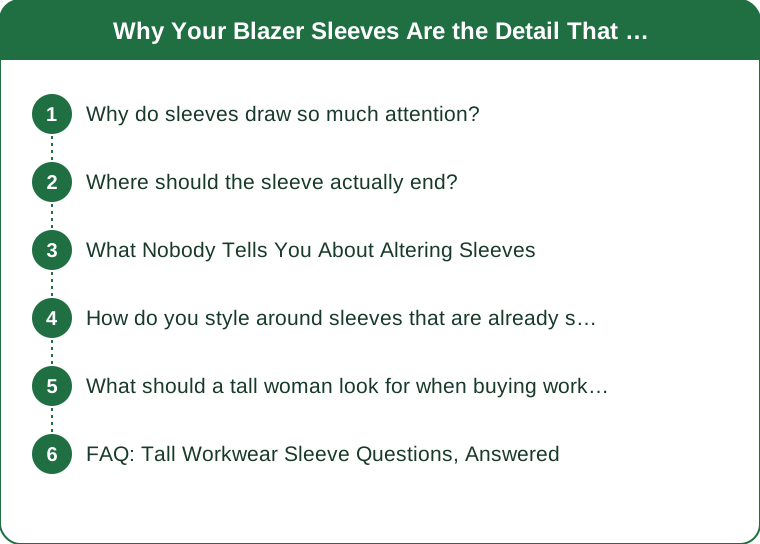
Why do sleeves draw so much attention?
Two reasons, and both are about where the eye goes.
Your hands are in nearly constant motion — gesturing, typing, holding a coffee, shaking hands. Motion attracts attention, and whatever borders that motion gets read carefully. A hem at your hip is static. A cuff at your wrist is in the frame every time you speak.
The second is contrast. A sleeve ending in the wrong place creates a visible band of skin where there should be none, or covers the hand where there should be a clean break. Both create an unresolved line at exactly the point people are already looking.
And on a tall frame, the error is usually larger. Standard blazer sleeves run 1 to 2.5 inches short on arms proportional to a longer frame, and tall ranges typically add only 1 to 1.5 inches. So even bought correctly, the shortfall is often still there.
Where should the sleeve actually end?
There is a real standard, and it is more specific than most people realize.
Jacket and blazer sleeve: ends at the wrist bone — the small bump on the outside of your wrist — with your arms relaxed at your sides. That is roughly where your hand begins.
Shirt sleeve underneath: extends about 1/4 to 1/2 inch past the jacket sleeve. This small reveal is what makes tailoring read as intentional rather than accidental.
Sleeveless or short sleeve: the hem should end either well above or well below the fullest part of the bicep, not at it.
Knitwear: slightly longer is acceptable and even desirable — to the base of the thumb is fine on a sweater and reads as relaxed.
Check it in a mirror with arms fully relaxed, not held out. Sleeves that look correct with arms extended will be short when you drop them.
What Nobody Tells You About Altering Sleeves
The advice everyone gives is to have sleeves shortened. Almost no one mentions that on a tall frame you usually need the opposite, and that changes the entire buying strategy.
You can rarely lengthen a sleeve. Most jackets have 1 to 1.5 inches of hem allowance inside the cuff, sometimes less. A tailor can let it down that far and no further, and on a jacket with functional buttonholes the answer is often no at all.
Which means: buy long and shorten. If you are between two options, take the one with sleeves that are too long. That is a $25 to $45 fix at any competent tailor. Sleeves that are too short are a permanent condition.
The second thing nobody says: sleeves can be shortened from the shoulder rather than the cuff. It costs more — typically $60 to $95 — but it preserves functional buttonholes and cuff detailing, and it is the right call on a jacket you plan to keep for years.
And a buying hack: men’s and unisex blazers in smaller sizes often have substantially longer sleeves and more hem allowance than women’s tall ranges. Shoulders may need work, but the sleeve problem disappears.

How do you style around sleeves that are already short?
Sometimes you own the jacket and the fabric is spoken for. There are legitimate ways to make it read intentional.
Push them up. A deliberate two-fold push to just below the elbow turns a fit error into a styling choice. This works on unstructured and soft-shouldered jackets; it looks wrong on formal structured tailoring.
Add a visible cuff. A shirt with a longer sleeve deliberately extending 1 to 1.5 inches past the jacket creates a layered look that reads as designed.
Use a bracelet or a watch at the break. Something at the wrist gives the eye a deliberate stopping point instead of an accidental one.
Choose three-quarter sleeves on purpose for the pieces you cannot fix. A jacket that is clearly, confidently three-quarter length is finished. A jacket that is accidentally almost-full-length is not.
The principle underneath all four: ambiguity reads as error, and commitment reads as intent. Half an inch short looks like a mistake; three inches short looks like a decision.
What should a tall woman look for when buying workwear?
A short checklist that saves a great deal of fitting room time.
Check sleeve length first, before anything else. It is the least fixable dimension. Shoulders can be adjusted, waists can be taken in, hems can be raised — sleeves have a hard ceiling.
Look for hem allowance. Turn the cuff inside out in the store. Visible fabric folded inside means a tailor has room to work.
Prefer soft shoulders on tall frames. Heavy padding adds visual width high on an already-long line and dates quickly.
Buy the jacket for the shoulders and the sleeves; alter everything else. Shoulder alterations are expensive and often not worth it. Waist suppression, sleeve shortening, and body hemming are all straightforward.
Budget for tailoring as part of the price. A $120 blazer plus $60 of alterations fits better than a $300 one off the rack. For a tall frame, this is not a compromise — it is simply the only path to correct fit.
FAQ: Tall Workwear Sleeve Questions, Answered
How do I measure my sleeve length correctly?
With your arm relaxed, measure from the top of your shoulder, down the outside of your arm with a slight bend at the elbow, to your wrist bone. Note that number and compare it to published garment sleeve measurements.
Are tall ranges worth it for blazers specifically?
Sometimes — but check the actual sleeve measurement rather than trusting the label, since tall blazers often add body length while adding little to the sleeve. A regular blazer with generous hem allowance may serve you better.
Do functional buttonholes make alteration impossible?
Not impossible, but it forces the more expensive shoulder alteration. If you buy a jacket with working cuffs, buy it with the sleeve length already correct.
TL;DR:
- Sleeves sit next to constantly moving hands, so length errors there are the most visible fit problem on a tall frame.
- Correct is at the wrist bone, with a quarter inch of shirt cuff showing.
- Sleeves can rarely be lengthened more than an inch — always buy long and shorten.
- If a sleeve is already short, commit to a push-up or a visible cuff so it reads as intentional.
The blazer that never quite looked finished was probably fine everywhere except the last two inches. That is a one-visit, one-hour fix — and it is the difference between clothes that fit and clothes that look like they were made for you.
Keep Reading
This article is for general informational and styling purposes only. Fit, sizing, and product availability may vary.